
Empowering Senior Voices:
City North Precinct
A case study from Empowering Senior Voices: a citizen-science methodology helping older adults document and reshape the neighbourhoods they live in.
A city through older eyes
The City North Precinct is changing fast with new towers, new footpaths and new rules. Twenty-three older residents set out to document what that change actually feels like to live through.
Empowering Senior Voices gave them a supported process to turn everyday observations into evidence for real change.


Every great journey starts with a walk
Walk with us. Show us what you see.
Instead of asking older adults to complete another survey, Empowering Senior Voices invited them to become citizen-scientists, walking their own neighbourhood, camera and voice recorder in hand, deciding for themselves what mattered enough to document.
The Story
The idea began with a gap: older residents are often surveyed about ageing, but rarely equipped to generate their own evidence about the places they live.
Professor Bernardo Figueiredo had spent several years looking for the right opportunity to partner with Stanford University's Our Voice initiative, and learn more about this international citizen science methodology (watch a short explainer) . That opportunity arrived through RMIT's City North Activation Challenge, bringing together multi-disciplinary researchers, the City of Melbourne, community organisations and older residents around a shared question:
Could citizen science help build healthier, more inclusive neighbourhoods?
From methodology to innovation
To adapt the methodology to the City North context, and to tailor it to the needs of the project, the team extended Stanford's original framework with two new stages (Prepare and Future Focus) embedding ethical community engagement and the envisioning of a collective future.
Walk with us
-
Explore each stage of the Empowering Senior Voices - City North Precinct Project methodology.
-
Select the tabs below to see how older residents became citizen-scientists and transformed local observations into community action.
Building the foundations
Every successful journey begins with preparation.
Before the first discovery walk took place, the project focused on building relationships with older adults, councils, researchers and community organisations.
Citizen-scientists were recruited through trusted networks and participated in onboarding sessions to understand the project, ethical considerations and how to use the Discovery Tool.
By the time participants stepped into the neighbourhood, they weren't simply volunteers, they were equipped to become observers, storytellers and contributors to future planning.
Key milestones
-
Recruitment of 23 citizen-scientists
-
Collaboration across 9 research and community partners
-
Ethics approval and participant onboarding
-
Discovery Tool training
-
Planning seven Discovery Walks across the City North Precinct


Walk the precinct through their eyes
The StoryMap brings together every observation captured during the discovery walks. Explore the geo-tagged photographs, comments and ratings collected by citizen scientists to see the City North Precinct through their eyes.
How to explore:
-
Click any coloured marker to open an observation.
-
Browse the photos and comments collected during the walks.
-
Zoom and pan around the map to explore different locations.
-
Look for recurring themes across the neighbourhood
-
Select different markers to compare how participants experienced different parts of the precinct.
Each point represents a real place documented by participants during the discovery walks.
Slowing down changes what you notice.
Normally we walk so fast in the city we don't see anything.
Healthy ageing is about place, not just healthcare. Footpaths, lighting, seating, trees, safety and social connection all shape whether someone can age well where they live.
Turning observations into action
The discovery walks were only the beginning. Participants came together with researchers, community partners and City of Melbourne representatives to interpret what they had documented. Working collaboratively, they transformed hundreds of individual observations into shared priorities and practical ideas for creating a healthier, more age-friendly City North Precinct.
Making sense together
The power of the methodology lies not only in collecting data but in interpreting it together.
During collaborative workshops, citizen-scientists and researchers reviewed hundreds of observations, identified recurring patterns and explored why particular places mattered.
Rather than researchers analysing data alone, participants worked together to group themes, discuss priorities and identify opportunities for change.
Workshop outcomes
-
Reviewed evidence from seven Discovery Walks
-
Analysed 350 photographs, 270 voice recordings and 55 written reflections
-
Identified recurring issues and community strengths
-
Prioritised opportunities for improvement
-
Agreed on the themes that mattered most

Eight priority themes emerged
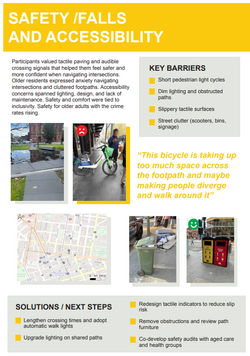
Every participant experienced the precinct differently, yet clear patterns quickly emerged. Together, citizen-scientists grouped hundreds of observations into eight priority themes that now provide a community-led roadmap for creating a more inclusive, accessible and age-friendly City North Precinct.
Select a theme below to explore the evidence, participant insights and recommendations that informed the project.
 Safety/Falls & Accessibility |  Equity & Inclusion in Public Spaces |  Regulation & Enforcement |
|---|---|---|
 Infrastructure & Maintenance |  Sustainability & Green Infrastructure |  Collaboration & Partnerships |
 Community Engagement | 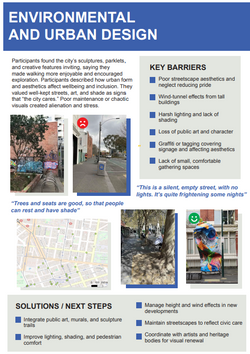 Environrmental Urban Design |
Where the journey leads
Discussion and evidence don't end a project, they start one. Here's what changed, and what continues.
From ideas to outcomes
The project demonstrated how community knowledge can influence real-world decision-making. Insights gathered during the Discovery Walks and workshops were translated into practical resources, policy conversations and public engagement activities that continue to support healthier, more inclusive neighbourhoods.
Project impact
-
Strengthened collaboration between community, researchers and government.
-
Demonstrated the value of participatory citizen science.
-
Created practical resources to support future projects.
Project outputs
-
Policy Brief
-
Civic Brief
-
Interactive Exhibition
-
ABC Radio Melbourne interview
-
Project video
-
Community feedback
-
Final research report


As we get older, it's easy to feel like your voice matters less
Empowering Senior Voices begins with a different belief, that older adults are experts in their own lives, and the city looks different when you slow down long enough to truly see it.
They are not just participants. They are co-creators in this project.
Prof Bernardo Figueiredo
Rather than ending with a set of recommendations, City North became the model for something ongoing, a Future Focus stage that keeps the relationships, evidence and momentum alive well beyond this one precinct.
Find out more
Explore the Policy Brief, full research report and interactive resources from the City North Precinct project.
Partner with us
Want to bring Empowering Senior Voices to your council, precinct or organisation?
Key partner organisations


Our team & acknowledgements
Academic researchers and collaborators from RMIT University
School of Economics, Finance & Marketing: Professor Bernardo Figueiredo (Project Lead), Associate Professor Kevin Argus, Dr Sarah Sinclair, Dr Avni Misra, Ms Marleen Campbell, Ms Lizzy Li
School of Media & Communication: Distinguished Professor Larissa Hjorth, Associate Professor Diana Bossio, Dr Caitlin McGrane, Dr Jenny Robinson, Mr Shahee Ilyas
School of Management: Professor Johanna Macneil
School of Global, Urban and Social Studies: Professor Lisa Given
School of Computing and Information Systems: Associate Professor Ryan Kelly
School of Design: Associate Professor Troy Innocent, Dr Jacob Sheahan
School of Computing Technologies: Dr Kate Anderson, Dr Elham Naghizade
School of Geospatial Science: Dr Alan Both
Centre for Urban Research: Dr Lucy Gunn. School of Engineering: Dr Afshin Jafari
School of Health and Biomedical Sciences: Dr Dein Vindigni.
Academic researchers and collaborators from university partners
Stanford University - School of Medicine: Professor Abby King, Dr Sofia Analise Portillo
University of Melbourne - School of Computing and Information Systems: Professor Jenny Waycott
Australian National University - College of Business and Economics: Dr Mark Buschgens,
Collaborators from project partners
City of Melbourne: Olivia Ng and Kimberley Pierzchalski
Acknowledgement
We extend our sincere gratitude to the 23 older adults who participated as citizen scientists in this project. Their experiences, insights, and commitment formed the foundation of Empowering Senior Voices, demonstrating the power of community-driven innovation for healthy and inclusive ageing.